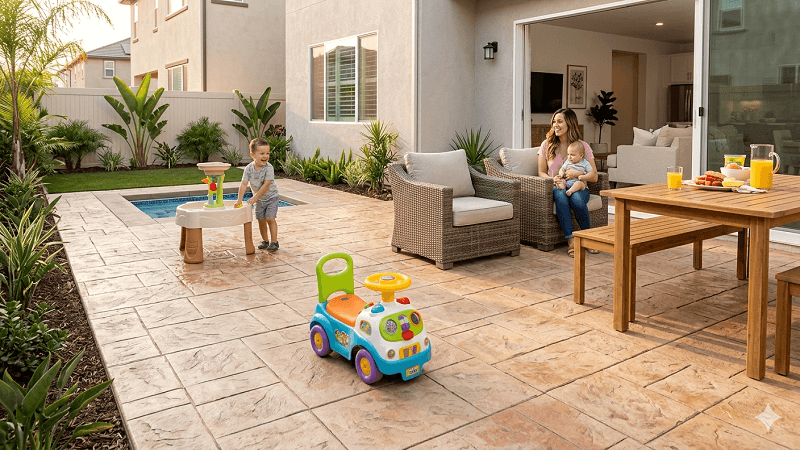
When you start planning a family-friendly patio design, you quickly realize you face a tough balancing act. You want a gorgeous, peaceful spot to drink coffee or host a dinner party after the kids go to sleep. But during the day, that exact same space turns into a high-energy, chaotic play zone.
I talk to parents about this all the time. They spend thousands on beautiful outdoor furniture, but they completely ignore the ground underneath it.
Here is the hard truth. You cannot build a safe garden for toddlers on top of a bad foundation. If you use the wrong materials, your backyard will quickly fill up with tripping hazards, slippery puddles, and annoying weeds. Let me show you what actually happens when kids play on bad surfaces and how we fix the ground to give you a permanent, safe space.
Why a Family-Friendly Patio Design Must Stay Flat
When people look for child-safe backyard ideas, they often buy hundreds of small brick pavers. They think a classic brick look feels cozy.
What actually happens is a nightmare for little feet. Builders do not glue pavers together. They just drop them in the dirt and sweep loose sand into the cracks. When it rains, the water washes that sand right out from under the bricks. The heavy bricks sink unevenly into the mud.
Suddenly, you have jagged, raised edges all over your yard. When your toddler runs across the patio, they catch their toe on a raised brick and take a hard fall.
To stop this from happening, modern parents upgrade to solid rock. Instead of loose puzzle pieces, we pour a thick, monolithic concrete slab. This means the floor is one giant, heavy piece of stone that physically cannot shift or sink. Many families choose stamped concrete patios because we can press a beautiful, realistic stone texture right into the wet rock. You get the expensive look of custom stone, but the ground stays perfectly flat and safe for ride-on toys and running feet.
Creating a Slip-Resistant Family-Friendly Patio Design
Summer means water. Whether your kids are splashing in a wading pool, running through a sprinkler, or just enjoying summer water activities, wet feet will eventually hit your patio.
A wet patio scares parents, and for good reason. If you have a smooth tile floor or a badly sealed patio, it turns into a terrifying ice rink the second water hits it.
You do not have to live with a slippery deck. We can fix the surface completely invisibly. When we seal a solid patio to protect the color, we open the bucket of liquid sealer and pour in a special traction grit. We mix it up heavy. When we roll this clear coating over your rock, it dries completely transparent. You cannot see it. But when a wet foot steps on it, the floor feels like medium-grade sandpaper. That invisible grit grabs bare feet and stops slips immediately, giving you a truly slip-resistant patio.
Building a Weed-Free, Low-Maintenance Outdoor Space
Parents are busy. You do not want to spend your only day off doing heavy yard work.
If you have a patio made of loose stones or wooden decking, nature will attack it. Seeds blow into the sand joints and sprout thick weeds. Ants dig the sand out to build massive hills. You end up sitting on your hands and knees all Saturday, spraying chemicals and pulling grass just to make the space look decent again.
If you are looking for time-saving tips for busy parents, replacing your loose bricks with a solid poured patio is a massive win. Because a stamped concrete slab has zero open sand joints, weeds have absolutely nowhere to grow. Ants cannot dig through solid rock. You get a totally low-maintenance outdoor space. When it gets dirty, you just rinse it off with a garden hose and go back to relaxing.
The Secret to a Dry Family-Friendly Patio Design
A great patio also protects your actual house.
If you build a large, flat play area right next to your back door, rainwater needs a place to go. If the ground sits perfectly level, the water just pools up. It creates a giant, muddy puddle right where your kids want to play. Even worse, that deep water pushes against your house walls and can leak inside.
You must control the water. We do this by pitching the concrete. We slightly tilt the massive heavy slab away from your house. The tilt is so small you cannot see it with your eyes, but gravity feels it perfectly. The rain hits the patio and instantly rolls out into the grass.
To get this invisible engineering right, you cannot just hire a guy with a shovel. You need to hire an experienced Concrete Contractor or local structural experts in your area who know exactly how to grade the dirt and slope the rock safely.
Conclusion
You do not have to choose between a beautiful backyard for adults and a safe play zone for your children.
A smart family-friendly patio design simply means making better choices about the dirt. Skip the loose, sinking bricks and the slippery tiles. Build a solid, flat, weed-free foundation. When you lock down the ground with a slip-resistant surface and proper drainage, you stop worrying about scraped knees and weekend chores. You finally get an outdoor space your whole family can actually enjoy together.
[H2] Frequently Asked Questions (FAQs)
What is the safest patio material for toddlers?
A solid, poured concrete slab is generally the safest option. Because it is one continuous piece of rock, it does not suffer from uneven sinking or shifting like loose bricks do, completely eliminating sudden tripping hazards.
How do I stop my kids from slipping on a wet patio?
You need to change the surface texture. You can hire a professional to wash your current patio and apply a fresh coat of clear acrylic sealer that is heavily mixed with an anti-slip polymer traction grit.
Does a family-friendly patio design require a lot of maintenance?
Not if you build it with seamless hardscaping. Solid poured patios do not grow weeds and do not require resetting. You only need to wash the surface with a standard hose and reapply a clear sun-protecting sealer every three to four years.