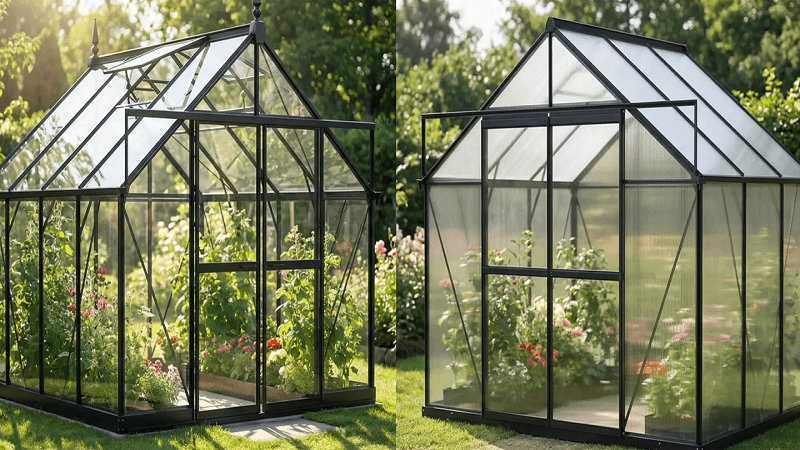
In commercial greenhouse construction, choosing the glazing material is more than a design choice; it is essentially a long-term business decision. When you are constructing large-scale farming buildings, selecting a material affects cost, longevity, energy efficiency, and, ultimately, your return on investment.
Commercial greenhouses were once primarily made of glass. The topic has, however, changed these days. With a surge in polycarbonate use, buyers are increasingly comparing polycarbonate sheets for greenhouse applications with traditional glass, particularly for commercial and industrial applications. This article should help B2B purchasers, installers, agribusinesses, and project planners determine which option is worth the investment over time.
We’ll cover performance, safety, cost, and scalability in a straightforward manner so you can make confident, well-informed decisions.
Getting To Know The Different Materials For Greenhouse Glazing
Why is Glass Used for Greenhouses?
For a long time, glass has been the go-to material for greenhouse glazing. Its main draw is its transparency and timelessness. Many greenhouses are still constructed of glass, especially those with architectural or heritage styles, because it provides high direct light transmission and is visually appealing.
In a commercial setting, glass is usually part of highly controlled environments that include botanical gardens, research facilities, or display greenhouses, where not only plant growth is considered but also the attractiveness of the plant area. Glass is also limited by a number of factors, especially when the main priorities are durability, safety, and energy efficiency.
What are Polycarbonate Sheets for Greenhouse Applications?
Polycarbonate sheets for greenhouse are plastic panels that are produced to give the best combination of light, insulation, and strength. They are typically available in single-wall, twin-wall, and multi-wall configurations, offering varying levels of insulation and differing structural properties.
What makes them so popular is their performance. First, polycarbonate panels scatter light more evenly; second, they retain heat better; and third, they are more impact-resistant than glass. For many commercial growers, all of these mean less money spent on operations and fewer interruptions.
Polycarbonate vs Glass Greenhouse: Important Differences
Light Transmission & Crop Performance
Glass provides excellent clarity, allowing direct sunlight in with minimal diffusion. This can benefit some crops but can also cause uneven light distribution, resulting in areas that receive too much light and others that receive too little, leading to plant stress.
On the other hand, polycarbonate for greenhouse panels naturally diffuses light, ensuring it is evenly distributed across the growing area. This way, plants will be more uniform, and there will be less risk of leaf burn, which is an effective method for saving plants in large commercial greenhouses.
Thermal Insulation & Energy Efficiency
Glass has minimal insulation properties. Heat is lost quickly, particularly in cold months, so you will use heating appliances more.
Polycarbonate sheets, particularly multiwall types, contain air pockets within their layers. Hence, they provide much better thermal insulation. B2B customers operating year-round can achieve energy savings through heat retention and secure more stable heating costs. Eventually, this will be reflected in the bottom line.
Strength, Impact Resistance & Safety
Being brittle in nature, glass is prone to breaking. If the breakage occurs during shipping, installation, or due to extreme weather, it may not only be hazardous but also likely to incur unexpected costs.
Polycarbonate sheets for greenhouse are highly durable and hardly break if handled normally or subjected to normal wear and tear. Such qualities make these materials perfect for commercial sites where safety, reliability, and weather resistance are major concerns.
Weight & Structural Requirements
Glass is quite heavy, which means it requires more structural support and makes installation more complex. This often results in higher engineering and labour costs.
Polycarbonate panels are lightweight, making them easy to carry, ship, and install. If the project is large, this feature will save you significant time during installation and make the structural design more accommodating.
In summary:
| Feature | Glass Greenhouse | Polycarbonate Greenhouse |
| Light Quality | High clarity; direct sunlight. Can cause “hot spots” or leaf burn. | Naturally diffused light. Promotes uniform growth and prevents scorching. |
| Insulation | Poor heat retention; high energy loss in winter. | Superior insulation (especially multiwall). Lower heating costs. |
| Durability | Brittle and prone to shattering from hail or impact. | Impact-resistant. Virtually unbreakable under normal conditions. |
| Safety | High risk of injury from sharp shards if broken. | High safety profile; shatterproof material. |
| Weight | Very heavy; requires heavy-duty structural framing. | Lightweight. Reduces shipping costs and structural requirements. |
| Installation | Complex and labour-intensive due to weight/fragility. | Fast and easy; panels are easier to handle and cut. |
Are Polycarbonate Greenhouses Any Good for Commercial Use?
This is a question B2B buyers ask frequently: Are polycarbonate greenhouses any good in real-world commercial settings?
The short answer is yes, and more and more so. Businesses choose polycarbonate because it provides:
- Longer service life with less replacement effort
- Less upkeep needed
- Decreased downtime caused by breakage
- Stable performance in different weather conditions
They are excellent for agricultural greenhouses and nurseries, as well as for research and commercial projects where reliability is more important than aesthetics.
Cost Comparison: Glass vs Polycarbonate for Greenhouse Projects
Initial Material Cost
Glass can definitely be a cheaper option if only the material cost is considered, without regard to performance. However, polycarbonate panels usually have a better price-to-performance ratio. Tempered polycarbonate panels for greenhouse do have the properties of being durable and energy efficient, thus saving on invisible costs.
Installation & Labour Costs
Glass necessitates delicate handling, and the labour must be highly skilled. Besides, more protection is required during transport. It is common for pieces to break during installation.
Polycarbonate sheets are easy to cut, install, and fit; total labour time will be reduced, and scrap will be minimal. This time savings is a significant advantage, especially when the project is a multi-unit or commercial repeat.
Long-Term Value & ROI
One thing is for sure: in the long run, a greenhouse made of polycarbonate can generate more returns than one made of glass. Therefore, energy conservation, proper maintenance, and a lower replacement frequency can be the main reasons for the strong case being made; this is especially true for those in the greenhouse business for the long haul.
| Feature | Glass Greenhouse | Polycarbonate Greenhouse |
| Initial Material Cost | Lower Upfront. Standard glass is often cheaper per pane, but doesn’t include “invisible” performance costs. | Higher Upfront. Quality panels (e.g., 4mm–10mm) have a higher base price but offer better price-to-performance. |
| Price Point (Approx.) | £1.50 – £1.90 per sq. ft. (Base material only). | £0.09 – £1.50 per sq. ft. (Varies by thickness: 4mm twinwall is the most budget-friendly). |
| Installation & Labor | Expensive & Risky. Requires highly skilled labour, delicate handling, and extra protection during transport. | Cost-Effective. Lightweight and easy to cut/fit; significantly reduces total labour hours and breakage waste. |
| Shipping & Logistics | Heavy and fragile; leads to higher freight costs and frequent “transit breakage” replacement costs. | Easy to Ship. Lightweight nature allows for cheaper bulk transport; virtually zero risk of shattering in transit. |
| Energy Costs | High. Minimal insulation means 30–50% higher heating bills in cold months. | Low. Multiwall air pockets provide 60% better thermal insulation, lowering year-round utility bills. |
| Long-Term ROI | Best for 25+ year “permanent” structures. Higher maintenance/heating costs offset initial savings. | Superior Short-to-Mid Term ROI. Huge savings on energy and maintenance make it the “smart” business choice. |
Why B2B Buyers Prefer Polycarbonate Panels for Greenhouse Projects
Consistency and scalability are what wholesalers and project managers consider. Using polycarbonate panels for greenhouses ensures consistent performance across all locations.
- Highly scalable and suitable for wholesalers and project managers handling large or phased greenhouse construction projects.
- Bulk-buy pricing to help keep costs down and simplify supply planning.
- Consistent panel quality allows for predictable outcomes in commercial applications.
- Different thicknesses can be used to meet diverse structural and insulation requirements.
- Integrated UV protection to prolong panel life and safeguard crops.
- Manufacturer warranties that reduce long-term risk for B2B buyers
If you’re sourcing materials, exploring specialized suppliers of polycarbonate sheets for greenhouse applications can simplify procurement and ensure compliance with commercial standards.
Best Use Cases for a Greenhouse with Polycarbonate
- Commercial poultry farms and poultry-raising farms require long-lasting, energy-efficient polycarbonate hollow sheets.
- Horticultural nurseries require constant growing conditions and dependable glazing.
- Schools and research greenhouses require safe, durable materials.
- World-class commercial greenhouse construction projects for year-round production.
- Vertical farming installations such as these use lightweight, insulating, and flexible glazing systems.
When Glass May Still Be the Right Choice for You and Your Project
Glass remains a key material in architectural and conservation greenhouses where visual transparency is required. Public display or historic preservation projects may prioritise appearance over energy efficiency.
In non-impact, controlled environments, glass can still perform, but these applications are becoming increasingly specialised.
Selecting the Suitable Polycarbonate For Greenhouse Panels
Determining which panel is suitable depends on the situation. Thickness affects insulation and strength, and the UV-protected layers enhance the panel’s durability. Climate-appropriate panel construction and local building requirements must be observed.
Place, wind load, and temperature changes determine the best choice. Reliable manufacturers such as The Polycarbonate Roofing provide guidelines to help you meet commercial building regulations.
Final Verdict: Should I Use Glass or Polycarbonate for a Greenhouse?
When it comes to glass vs. polycarbonate sheets for greenhouse applications, the answer is “it depends” on what you are willing to compromise on. The glass provides clarity and tradition, but the polycarbonate offers durability, energy efficiency, and scalability.
Polycarbonate is often the smarter option for B2B buyers who are value-driven in the long run, safety-conscious, and whose machinery operability is very important. It has lower maintenance requirements, insulates better, and has been proven to withstand modern commercial greenhouse conditions.
When it comes to reliability, trust the manufacturer’s industry expertise to deliver solid, consistent results for you. The Polycarbonate Roofing brand remains a trusted name in greenhouse supplies, enabling UK buyers to build stable, comprehensive structures.
FAQs
1. Are polycarbonate greenhouses good for commercial farming?
Yes. They are also durable and energy-efficient, making them ideal for commercial applications.
2. How long can polycarbonate greenhouse panels last?
If the appropriate thickness is used for the application, high-quality panels can last 10 to 20 years or longer.
3. Will polycarbonate panels help keep heating costs down?
Yes. Due to their insulation, they help retain heat in buildings and reduce energy consumption.
4. Is polycarbonate safer to use for greenhouses than glass?
Absolutely. Polycarbonate is safer for greenhouses.
5. Can a large industrial greenhouse be built using polycarbonate?
Yes. It is also prevalent in vertical and industrial farming.