
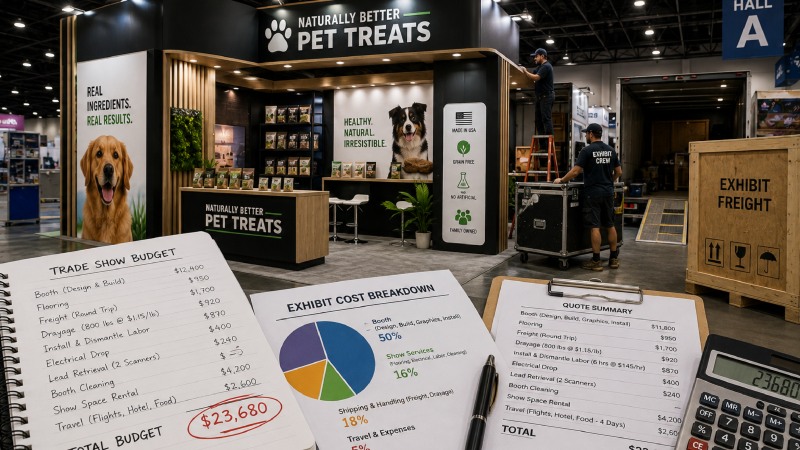
The quote said $12,400, and the check they actually wrote for their first Anaheim expo came to $24,900. Nothing was padded and nobody overcharged; the couple had simply read a bid from a custom trade show booth company california as the price of exhibiting, when it was the price of one line on a much longer invoice. They make pet treats. Two people, one commercial kitchen, a folding table at California farmers markets since 2022, and a hard ceiling of $25,000 for the show that was supposed to move them into wholesale accounts. The argument of this piece fits in a sentence: a show budget is not a booth budget, and the only way to see the real number before you commit is to have the entire scope quoted as one program instead of six.
The Deposit Is Not The Whole Cost
A deposit buys design time and fabrication. It does not buy the floor the structure stands on, the truck that carries it, the crew that stands it up, or the power running to the screen you spent three weeks arguing about. Those arrive later, from different companies, on different terms, and usually after the ceiling in your spreadsheet has already been set in stone. The case we see most often is a small brand that budgeted the booth and forgot the show.
None of this is happening in a forgiving market either. CEIR’s Q3 2025 index, reported in December 2025, found attendance still running 12.3% below 2019 levels while real exhibition revenues sat 18.2% below, the widest gap between those two measures the organization tracks. Read that as a warning about pricing rather than about aisles. The room may be slightly thinner than it was, while the cost of standing in it has not moved down to match, so a first-timer has less room to absorb a surprise.
Sticker shock arrives in installments.
Freight, Drayage And Labor Arrive Separately
Freight is the obvious one, and it is round trip, not one way. Drayage is the charge for moving your crate from the dock into your space and back out again, billed by weight with a minimum that small exhibitors almost always trip. Installation and dismantle labor is hourly, often with an overtime window nobody mentions until the crew is standing there at 5:30 in the evening. Flooring, an electrical drop, lead retrieval scanners and booth cleaning each carry their own order form, and each one closes on its own deadline with its own late fee.
I cannot give you a dependable average for drayage, and I have stopped pretending I can. Rates swing by venue, by the labor agreement in force there, and by whether your crate goes to the advance warehouse or straight to the show floor. Every tidy national figure I have seen quoted for it has been contradicted by the next exhibitor kit I opened, so treat the single-number versions with suspicion. Pull the actual per-hundredweight rate and the minimum from the show’s own exhibitor services manual, then budget from that number instead of from an average that may not describe your building at all.
Running The Real Number On Paper
For their second show the couple did it the other way around. They asked a custom trade show booth company california exhibitors in their category kept naming to price design, build, graphics and install as one scope, then added the organizer’s charges and their own travel underneath it. One page, one total, agreed before a deposit left the account.
The arithmetic looked like this. A 10 by 20 custom inline structure with printed graphics ran $11,800. Flooring added $950, round-trip freight from Southern California added $1,700, and drayage on an 800 pound crate at $1.15 per pound came to $920. Install and dismantle took six labor hours at $145 an hour, or $870. The electrical drop and two lead retrieval scanners totaled $640. Space rental from the organizer was $4,200, and four days of hotel, flights and food for two people ran $2,600. That comes to $23,680 all in, roughly $1,300 under their ceiling, with nothing left to land in the mailbox in March.
Substitute your own figures and the shape holds. The structure is usually somewhere between a third and half of the total, and everything else is the show itself. Once you can see that split on paper, the conversation with a builder changes from what can you do for $12,000 into what does the whole thing cost, which is a much harder question to answer badly.
Build Once And Spread The Cost
If one show is all that sits on the calendar this year, rent the structure and keep the cash. If three or more are booked inside eighteen months, owning the frame usually wins, because the build is the only cost in the list that does not repeat. That $11,800 structure spread across three shows is about $3,930 a show, and refreshed graphics for a new product line run a fraction of the original print bill rather than the whole thing again.
The couple ended up at three expos in their second year, selling into two regional chains off the back of them. What changed was not the size of the booth. What changed was that the number they approved in January was the number they paid by December because one company owned the full scope and quoted it that way. They also wrote down every cost the show itself charged before sending the deposit rather than discovering those costs afterward. Ask for the whole picture first. The build is the easy part.