
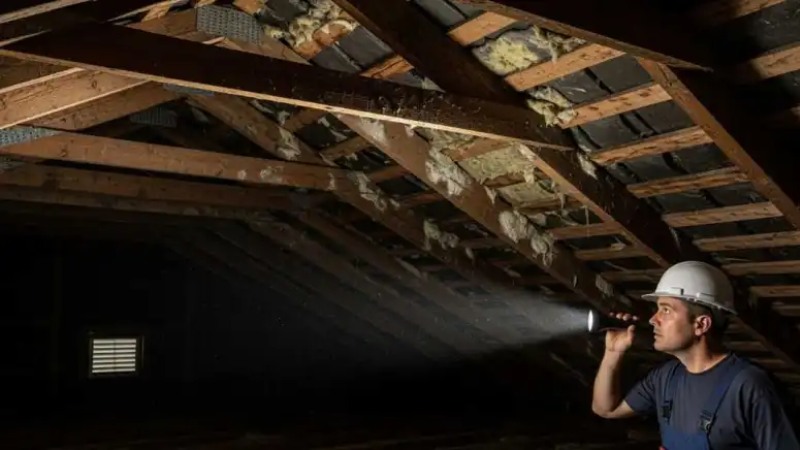
A musty upstairs hallway is not a housekeeping problem. In a 1990s Leawood two-story, a smell that arrives within a day of heavy rain and thins out by midweek is describing where water went, not how often anyone vacuums. Parents usually catch it first, since the toddler’s room sits on that hall and they pass through it a dozen times before lunch. The confusing part is what is missing: no puddle, and no brown ring on the ceiling to point at, just a closet ceiling that feels cool and slightly damp under your hand. That gap between the smell and the evidence is why the call to roofing companies Leawood KS parents ask around for often waits an entire season. The argument here is simple: damp air with no visible water usually means the assembly above the ceiling is holding moisture, so the first move is an inspection that locates the entry point rather than a cleanup of the part you can smell.
Damp Indoor Spaces Are Studied For Respiratory Effects
Damp housing has been studied for decades, and the findings are consistent enough that public health agencies treat indoor dampness as a condition worth correcting rather than tolerating. Reviews of that work report more coughing and more asthma flare-ups among people living in damp homes than among people living in dry ones. What the research does not do is diagnose your hallway. It describes patterns across large populations, which is a good reason to take a damp smell seriously and a poor reason to assume anyone in the house is already sick.
If someone at home has a cough that lines up with the smell, that is a question for a clinician, and the wet ceiling is a separate question for people who work on roofs. Keep the toddler out of the affected room until it is dry. If fuzzy growth turns up on the closet ceiling or the underside of a shelf, do not brush it or aim a fan at it, because disturbing it pushes spores into the air the family breathes. Federal remediation guidance from the EPA says anyone disturbing mold needs at minimum an N-95 respirator, gloves and eye protection, and that large areas of growth may call for occupants to be moved out temporarily while the work is done.
If The Smell Follows Rain Look Upward
Water almost never falls straight down onto the spot that smells. It gets in at a nail pop, a lifted shingle edge, a cracked boot around a plumbing vent or a gap where a dormer meets the main slope, then runs along the underside of the sheathing and soaks insulation several feet away. The pattern most often is a small entry point well uphill of the wet spot, which is why poking at the closet ceiling proves nothing. Your nose gets there before your eyes do. Attic insulation can hold a startling amount of water without one drop reaching the drywall below, and a two-story with a hallway ceiling under a low-slope section is a common place for that to happen quietly.
If the smell spikes within a day of rain and eases by midweek, treat it as water coming in from above. If it sits at the same strength no matter what the sky does, look instead at plumbing, at a bathroom fan venting into the attic rather than outside, or at humidity with nowhere to go. That one test sorts most of these situations before anybody climbs a ladder. A smell that tracks the weather is a water problem, not an odor problem.
Plenty of families wait anyway, because they assume the answer is a whole new roof and a five-figure invoice. That fear is not baseless. Insurance Journal reported in June 2026 that the average residential roof replacement in the United States reached $17,631 in 2025, roughly 33 percent above the prior four-year average, as material costs rose and the country’s roofs aged. An inspection is a different transaction entirely, and most of what causes a musty hallway turns out to be a repair. (Ours was a flashing detail the size of a paperback, which felt anticlimactic after three weeks of worrying about it.)
Dry The Cause Before Cleaning The Symptom
Cleaning first is the expensive mistake, because a scrubbed ceiling with a wet cavity above it comes back in the next storm and takes another month of the family’s attention with it. Order of operations matters here: find the entry point, stop the water, dry the assembly, then deal with whatever grew while it was wet. Drying is the part people skip. Saturated fiberglass does not quietly recover on its own in a Kansas attic, and insulation that stayed wet for weeks usually has to come out rather than be left to air. A dehumidifier in the hallway treats the air in the hallway and nothing above it.
When you gather quotes, ask what the inspection actually covers, whether the report names the entry point, and whether it comes with a photograph of the spot. Someone who can only tell you the roof looks old has not found anything yet. The roofing companies Leawood KS parents keep recommending tend to be the ones who explain the path the water took, in plain language, before they hand over a number. Follow the smell back to its source, dry out what got wet, and the upstairs hallway stays dry after the next storm.