
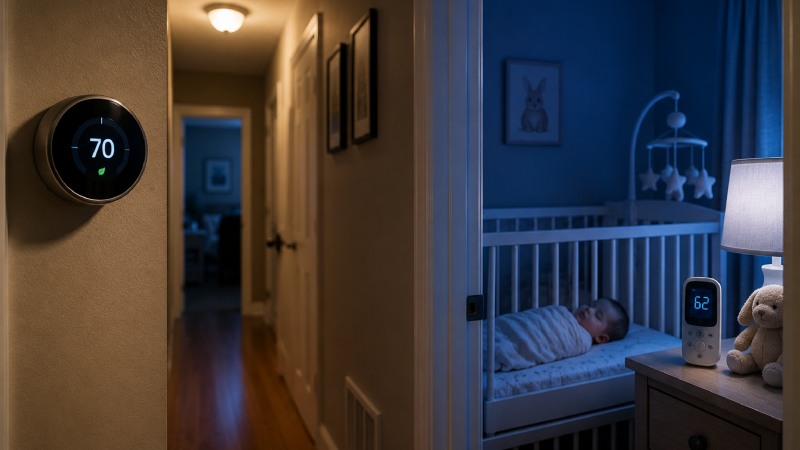
At 2:14 on a January morning I stood in a nursery in a 1970s Valley Station cape and watched a cheap digital thermometer settle on 62 degrees. Down the hall, the thermostat read 70, and the furnace was not running. Our daughter was four months old, and she was sleeping in the coldest room in the house. That gap between two numbers under one small roof is what this article is about, and it is not a thermostat problem. It took three weeks of reading, one wasted space heater and finally a call for hvac repair louisville ky before I understood the difference between a house that is cold and a house that cannot move its own heat.
Two In The Morning Reveals The Temperature Gap
The first thing I did was stop trusting a single number. I bought three cheap thermometers and put one in the nursery, one in the hallway directly under the thermostat, and one in our bedroom, then checked all three at two in the morning for a week, because that is when the gap ran widest. The nursery sat between 61 and 63 every night. The hallway held at 69 or 70. Our room, one door closer to the return vent, never dropped below 68. Seven nights of that and the pattern was clearly not weather. It was geography, and the far end of the duct run lost every single time the furnace cycled.
So here is the argument, stated plainly before the story goes any further: a cold nursery inside a warm house is almost always an airflow problem, and diagnosing and repairing the airflow on the furnace you already own solves it more reliably, and usually for less money, than any workaround you can plug into the wall. The thermometer does not care what the thermostat thinks. One room was not getting its share of the air, and until that changed, nothing else in the house was going to matter.
Space Heaters Buy Comfort At Real Risk
We bought a space heater on night nine. It worked, in the narrow sense that the room reached 68 and the baby slept through. Then I read the manual, and then I read a Cornell environmental health and safety page back in May 2026 that puts the clearance rule in plain numbers: three feet between a portable heater and anything that can burn, curtains and paper and plastic and cloth included. Our nursery is eleven feet by ten, holding a crib, a dresser and a floor length curtain. Three feet of genuinely clear space meant the heater belonged in the middle of the floor, which is not where you leave a running appliance in a room where a child sleeps.
The rest of the rules are not negotiable, so I will state them flat. Plug a portable heater straight into a wall outlet, never into an extension cord or a power strip. Never leave one running unattended in a child’s room, and that includes overnight while the whole house is asleep. Put a working carbon monoxide alarm outside every sleeping area and test it. A space heater is a bandage on a house that cannot move its own heat. We ran ours for eleven nights and I slept badly on all eleven.
Static Pressure Explained Without The Jargon
The technician who finally came out spent more time with a gauge than with the furnace. He measured what installers call static pressure, which is really just how hard the blower has to push to move air through the ducts you happen to have. The reading came back high. When static pressure runs high, the fan works, the burner fires, the thermostat reads satisfied, and the farthest room still starves, because air takes the easy path into whichever rooms sit nearest the trunk line. Ours was undersized flex duct with a sag in the middle of the run and a damper somebody had closed decades ago. Talk to anyone who does this work through a Louisville winter and what usually turns up is exactly that, a duct that was marginal the day the house was framed and got a little worse every year the filter went a month too long.
The second time I typed hvac repair louisville ky into my phone, I had measurements to describe instead of a complaint to make. Here is the part I still cannot tell you. I never wrote down what the static pressure read before the work, and the invoice only says the system was rebalanced, so I know the room warmed up and I cannot prove to you by how much the pressure actually dropped. Anyone who hands you a tidy before and after figure on a repair like this may be tidying it up on your behalf.
One Balanced System Beats Four Workarounds
Two weeks after the duct work, the nursery held within two degrees of the hallway on the coldest night of the month. Say a diagnostic visit runs seventy five dollars and the repair itself lands somewhere in the mid hundreds; measured against a heater we ran nightly, plus what it quietly added to a January electric bill, a permanent fix on equipment we already owned paid for itself inside one winter. The furnace also stopped short cycling, which nobody promised us and which we took gratefully.
One more thing belongs here, because it belongs in a parenting article more than it belongs in a furnace article. A furnace, a water heater and a gas range all burn fuel, and a house sealed up tight for winter leaves that combustion nowhere good to go when something fails. If a carbon monoxide alarm sounds, or if headaches and nausea hit more than one person at the same time, the Environmental Protection Agency’s published guidance on suspected carbon monoxide poisoning advises you to get fresh air immediately, open doors and windows, shut off the combustion appliances, get out of the house immediately, and go to an emergency room. Do not stay inside to troubleshoot the furnace first.
If your nursery reads sixty two while the hallway insists on seventy, the house is telling you something specific, and it is not that you need another appliance. Put a gauge on the system, find out where the air is actually going, and fix the path it travels. The equipment in the closet is probably fine. The ductwork it pushes through is the problem, and that is a repair rather than a replacement.