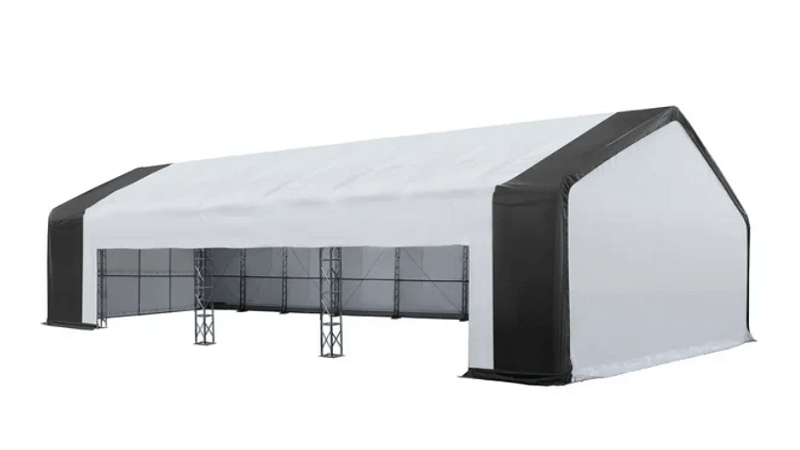
Across American farms, construction sites, and industrial yards, storing oversized equipment like combines, excavators, and semi-trailers requires substantial covered space. Permanent buildings are expensive and time-consuming to construct. A dual truss storage shelter workshop provides large-scale, weather-protected space that can be installed quickly on existing concrete pads. American farmers, contractors, and equipment dealers use these shelters to protect valuable machinery and create covered workspace for maintenance and repairs.
Common Applications and Design Features
This shelter workshop is commonly used for:
- Combine and large tractor storage on farms
- Construction equipment shelter at job sites
- Maintenance bay for heavy machinery
- Sawmill and woodworking shop space
- Oilfield and mining equipment housing
Drive-Through Design and Workflow Efficiency
The three 19 foot wide openings are a key design feature for equipment-intensive operations. A combine or excavator can drive in one opening, be serviced inside, and drive out another opening. This eliminates the need to back large equipment that has limited rear visibility. For maintenance shops, this design allows vehicles to enter for repairs and exit forward, improving workflow.
The 20 foot peak ceiling height provides clearance for equipment with tall attachments. Combines with vertical grain bins, excavators with raised booms, and large trucks with high roof clearances all fit comfortably.
Structural Strength and Weather Protection
The dual truss frame uses heavy-duty galvanized steel tubes on all trusses and purlins. The rectangular scaffolding-style support columns provide greater side impact resistance than round columns. This is important when large equipment is maneuvered inside the shelter where accidental contact with support columns can occur.
Ease of Assembly and Portability
The shelter is designed for assembly on a concrete pad or equivalent foundation. The galvanized steel frame bolts together, and the fabric cover attaches over the frame. Unlike permanent buildings, the shelter can be disassembled and moved to another location. This portability is valuable for contractors who work on multi-year projects and farmers who rotate equipment between fields.
The shelter is sold as a DIY installation. A forklift is required to unload the three shipping crates, which have a combined weight of 6500 pounds. The assembly itself does not require heavy equipment, but multiple people are needed for fabric handling.
Safety Practices and Operational Guidelines
Safe shelter use requires several key practices:
- Anchor securely to concrete pad with appropriate bolts
- Remove snow accumulation during heavy storms
- Check frame bolts for tightness annually
- Inspect fabric for tears or UV degradation
- Keep drive-through openings clear for emergency exit
While the shelter is designed for durability, extreme weather events may require additional precautions. In high wind areas, adding extra anchoring points is recommended. In heavy snow regions, manual snow removal may be needed. The shelter is not certified for specific snow or wind loads, so users should assess local conditions.
Advantages and Limitations
Advantages:
- 2640 square feet of covered space
- 20 foot peak height for tall equipment
- Three 19 foot wide drive-through openings
- Dual truss design for structural strength
- 21 ounce PVC cover for durability
- Scaffolding-style columns for impact resistance
- Portable and relocatable design
Limitations:
- Requires concrete pad or level foundation
- Not certified for specific snow or wind loads
- Fabric cover replacement needed after years
- Professional anchoring recommended
- Three crates require forklift for unloading
Real-World Application Example
An American farmer in Iowa owned three combines used for corn and soybean harvest. During winter, combines were parked outdoors, exposed to snow and ice that caused electrical issues and corrosion. A permanent building large enough for three combines would cost 150,000 dollars. The farmer installed an 80×33 dual truss shelter on an existing concrete pad. The 20 foot peak height accommodated the combines’ grain bins. Three 19 foot openings allowed each combine to park in its own bay. The farmer now performs winter maintenance inside the shelter, and the combines are protected from snow damage.
Conclusion and Future Outlook
Dual truss storage shelter workshops provide American farmers and contractors with affordable, large-scale covered space that permanent buildings cannot match in cost or portability. The combination of 2640 square feet, 20 foot height, and three drive-through openings makes these shelters suitable for combine storage, construction equipment yards, and maintenance workshops. As equipment sizes continue increasing, demand for tall, wide shelters will likely grow. Future designs may include thicker fabric for extended life and integrated lighting for night work.
Farm and site managers should evaluate dual truss shelters for any operation requiring weather-protected space for oversized equipment. The 80 foot by 33 foot size makes this shelter suitable for diverse American agricultural and industrial applications.